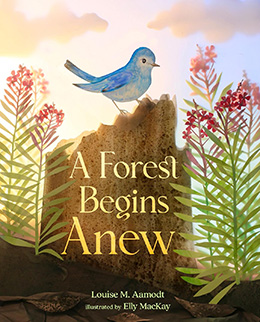
When I was growing up, my grandparents lived near the Chequamegon-Nicolet National Forest in northwestern Wisconsin. When there was an inevitable forest fire, my grandfather would note the date and start checking after three years … were there wild blueberries growing in the area? He’d gather up buckets and the family and we’d all go blueberry picking. Without the sun-blocking canopy of the forest, the small plants thrived.
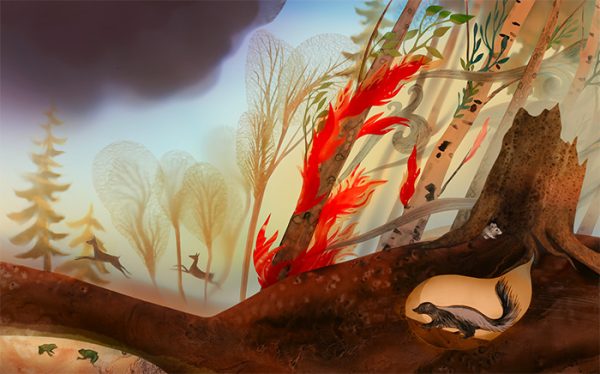
As the author says in the back matter in answer to the question Are Fires Good for the Environment?, “Well … yes and no. Tree rings and soil samples show that fire has always been a natural part of forest life.”
Those of us who know people who live within a forest or nearby, whose lives have been abruptly changed by a forest fire, know about the disbelief and grief that accompany a raging fire. Children in particular, those who haven’t experienced a fire, have many questions. What happened? How did it happen? What can we do? What happens next?
Author Louise Aamodt uses poetic text to take us from lightning striking a tree, through the burn, on to the forest and critters and people recovering. Poetry feels like the right approach … it’s not too heavy or dark and yet it still recognizes the big changes.
There’s a good deal of reassurance in Aamodt’s word choices. Yes, a forest fire is traumatic and affects many living beings, including trees, plants, insects, small and large animals, fish, birds, and people. But there is also renewal after a fire. A chance to begin again.
I would select A Forest Begins Anew for a read-aloud because it will engender discussion in a classroom or family den. It also provides many of the answers. The text flows well, essential for reading out loud. It also has many onomatopoeia words, providing an opportunity for drama.
Illustrator Elly MacKay shares that her illustrations “were created by photographing three dimensional scenes made with ink, pencil and paper. The animals are winsome and tucked throughout the pages, always relating to the text. The layering of images is intriguing. The cutting line is often visible, reminding us that these are illustrations and not actual views of the forest. The fire scenes are vibrant and, for me, breath-stopping.
The Hot Story Facts at the back of the book each taught me a great deal. I’m prompted to explore beyond this book. A bibliography and suggestions for further reading will help.
As the laboratories of the U.S. Forest Service are in danger of being closed (!) this book is good for both children and adults to read. Understanding the gravity of forest management is critical for everyone as we lend our voices and take action to protect our environment and the knowledge we must continue gaining to be good citizens of this Earth.
This would be a good pairing with some of this year’s MG novels about wildfires, for example Tae Keller’s When Tomorrow Burns or Chris Baron’s Spark.
I haven’t read either of them, Tricia, but now I will. Another MG, Caroline Starr Rose’s The Burning Season. I sense a book list developing.
Thanks for the ideas! My picture book brain sometimes forgets to think about other genres, so this is a great reminder.
I missed this book on my purchasing list. Thank you for sharing it!