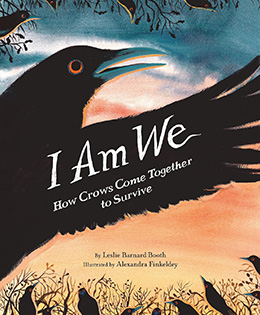
In I Am We, How Crows Come Together to Survive, writer Leslie Barnard Booth and illustrator Alesandra Finkeldey show us, through the voices of crows, how these birds come together for survival. The book begins,
I spill across the sky like ink–
Fill the night with jagged cries,
I have one thousand eyes…
What I mean to say is this:
I am not I at all.
When winter comes and early darkness fall, crows call to each other to roost together.
I follow him,
and he follows she,
and they follow me,
and me turns to we…
It’s hard not to quote all of this spare, poetic, beautiful book of a crow’s-eye view of survival or post a picture of the striking art of a crow’s-eye view of crows. Back matter gives more information about crow brains, families, talk, social learning, foraging, roosting, and winter survival. This stunning book reminds us that not only people coöperate to survive against adversity. Crows, too, know that their survival against the perils of nighttime depends on coöperation.
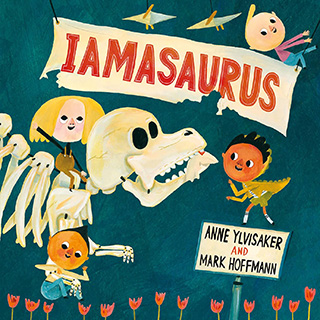 Iamasaurus by Anne Ylvisaker, with gleeful illustrations by Mark Hoffman, takes us on a romp to a dinosaur museum where children imagine themselves as Noodlevorous dinosaurs of the genus Ridiculorous. A security guard keeps an eye on them as they romp through the museum, proclaiming,
Mothers abhor us.
Babies adore us.
We romp and we stomp and
we chomp on the floras.
Double page spreads list rhyming parallels between dinosaur and human anatomy. “We’ve got maxillae, mandibles, clavicle, ribs/ scapulas, humeri, tibia, fibs.”
The book ends with an invitation:
“You can join us;
you’ve got your own
loud vocal cords.
We’re a chorus
Let’s ROARus! …
WEAREASAURUS!
The final spread shows the children — and the security guard — in full dinosaur. Who could resist the invitation to ROMP STOMP CHOMP ROMP STOMP CHOMP? Not the guard, and not the children we’ve shared this rollicking book with. From Iamasaurus to Weareasaurus, Ylvisaker shows that not only do we have physical commonalities with dinosaurs but that we also have more fun together.
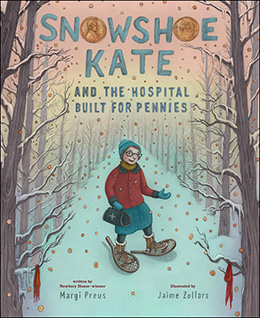
Margi Preus’s latest picture book, Snowshoe Kate and the Hospital Built for Pennies, illustrated by Jaime Zollars, recounts the true story of Dr. Kate Pelham Newcomb who became a doctor in the early 1900s but discontinued doctoring to care for her husband and family, living in a log cabin in the Northwoods of Wisconsin. When a local doctor needs her help she begins doctoring again, delivering babies and saving lives, travelling in bad winter weather by snowmobile, by hitching a ride on a snowplow, or even by snowshoe. When her grateful patients can’t pay cash, they pay her with firewood or food. When roads are passable her husband drives her on her visits, and she once “traveled 376 miles, made 17 house calls, visited 3 different hospitals in 3 different cities, and delivered 7 babies — all in under 36 hours.”
As some of her many babies that she delivered reach school age, a school assignment to visualize a “million of something” propels them to begin collecting pennies toward the hospital that they know Dr. Kate wants for the community. They write letters asking for donations, send out thank you notes, save their allowances. Area businesses set out collection containers for customers to contribute pennies.
Newspapers carry the story, and pennies pour in from forty-eight states and twenty-three foreign countries. By the end of the school year they have collected one million pennies — ten thousand dollars toward a hospital. The pennies continue to roll in until finally they have enough money to reminds us of what we can accomplish, bit by bit, person by person, penny by penny.
A double page spread at the back of the books shows photos of Dr. Kate and encourages us to do what we can to show appreciation for folks who do the very best they can even in the hardest and most trying time.
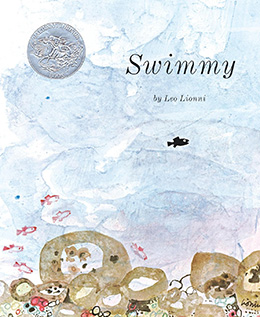
Children’s book writers have been writing about the strength of WE for decades. In 1963 Alfred Knopf published Swimmy, written and illustrated by Leo Lionni. This classic book — winner of a Caldecott Honor in 1964 — tells the story of small black fish who lived in a community of small red fish. Swimmy looked different and could swim faster — perhaps not “we.”
When the small red fish are devoured by a hungry tuna, Swimmy escapes, “scared, and lonely, and very sad.” He goes off to explore the sea. He sees a lobster that looks like a “water-moving machine,” an eel, “whose tail is almost too far away to remember.” Eventually Swimmy comes upon another school of small red fish, hiding from larger fish. He invites them to explore the sea with him. “We can’t,” they say. “The big fish will eat us.”
“Swimmy thought and thought and thought.” Eventually he has an idea. “We are going to swim all together like the biggest fish in the sea!” He teaches the fish to swim together, each in their own space, to create one giant fish, with Swimmy as the eye. “And so they swam in the cool morning water and chased the big fish away.”
Swimmy, the one who is different, saves the day. But Leoni’s gorgeous illustrations keep this story from being didactic. He gives us truth and beauty in this book. And that is why the book has been in print for 63 years.
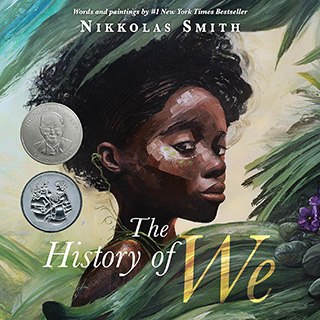
Nikkolas Smith has also given us truth and beauty in — The History of We. Each page is a gorgeous acrylic painting, done by Smith. Early in the book he writes in “the fertile African cradle … the birthplace of civilization is found. Here, we dreamed and we spoke. We shared and we healed. We sang and danced and built and explored. We lived. Let us travel back to the start, so far back / that all of our roots begin to tell the same story…the history of we.”
The revolutionary piece about this book, which was vetted by scholars in the Leakey family, is that Smith reminds us that we ALL started in this fertile African crescent. These people he portrays are ancestors to all of us. We came from the same place, no matter how much some may want to divide us now. He reminds us that those ancestors invented stories, danced, made music and song, built homes, studied the stars. He continues, “We cultivated bountiful harvests … We were skilled, graceful, fearless and fast in the flying wind.”
Of course we know that we did not all stay in that African cradle: “From the Mother Land into every corner of Mother Earth one group became many. Became extended cousins, developing an array of diverse complexions and forms of prayer. Became the first global population … Became We.”
He tells us in a youtube video that he was motivated to write this book because he never found books like this when he was in school. He wants all kids to know the history of we. This is a book to be shared and shared again.
Perfect choice for your theme. Thank you!