The benefits of gardening are well-documented, both for adults and for children. Adults may see improvement in physical health, mental well-being, and diet, for example, [1] while children gain hands-on STEM learning opportunities, social and emotional support, and awareness of environmental stewardship. [2] To help instill or nurture an interest in gardening, five Caldecott Honor books feature the wonders that gardens hold as places that provide sustenance, restoration, and a sense of mystery.
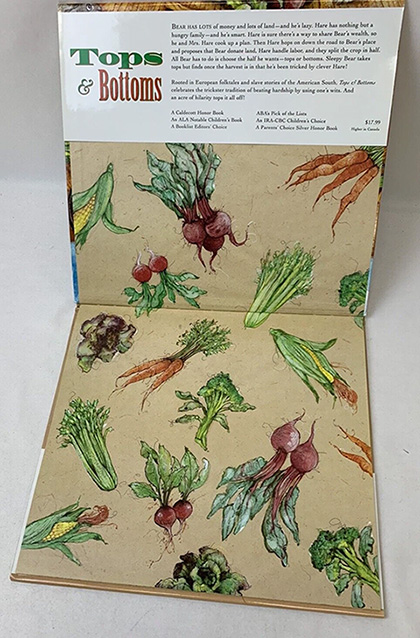
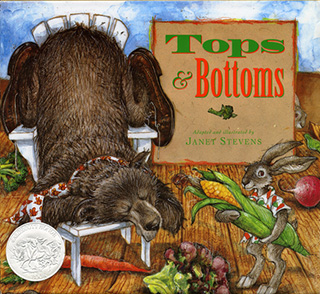
Illustrator Janet Stevens adapts a trickster tale for a contemporary audience in Tops & Bottoms. In this 1996 Caldecott Honor book, Hare is desperate to feed his hungry family after having to sell land to his lazy neighbor Bear. The pair strikes a deal: Bear will lend a plot of land to Hare, Hare and his family will plant and harvest the crops, and the two will split the bounty. When Bear requests “tops,” Hare plants carrots, radishes and beets. When Bear requests “bottoms,” Hare plants lettuce, broccoli, and celery. Finally, Bear requests “tops and bottoms,” and Hare plants corn.
Outsmarted three times, Bear “never again slept through a season of planting and harvesting.” Hare buys back his land, and his family thrives. While Stevens doesn’t include source notes, the front jacket flap informs readers that the story is “[r]ooted in European folktales and slave stories of the American South.” [3]
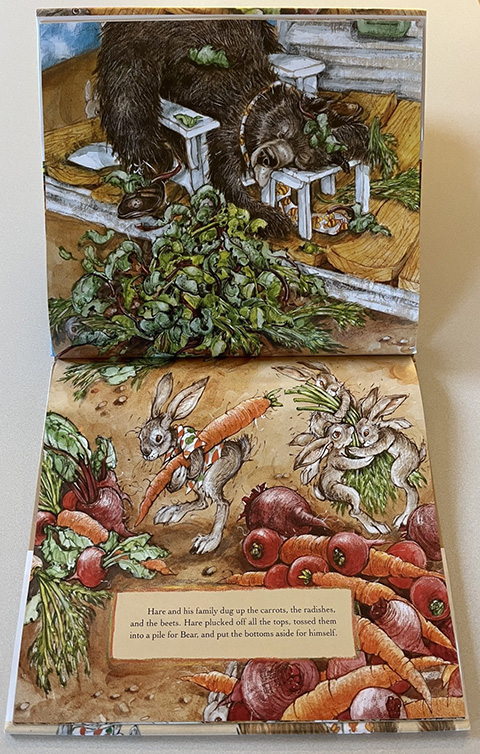
The most remarkable feature of the book is its orientation: Readers must turn it 90 degrees to open it vertically, an idea that Stevens came up with and suggested to her publisher. [4] The unusually tall spreads, most of which are full-bleed, barely contain the action. The disheveled sleeping Bear, flopping out of his chair, shifts from the top of the illustrations to the bottom, then back to the top as his agreements with Hare change. With watercolor, colored pencil, and gesso on earth-toned handmade paper, [5] Stevens uses a child-friendly cartoon style to infuse humor into the story. A range of neutrals and greens dominate the spreads. The endpapers are filled with the tops, bottoms, and middles from the hare family’s bounty.
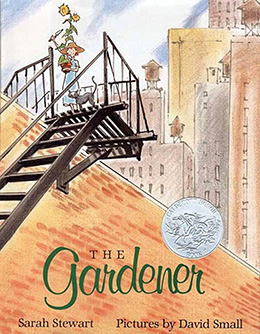
Beyond a successful harvest, the rewards of gardening can be derived from creating and sharing a place of beauty. Sarah Stewart’s The Gardener, illustrated by her husband David Small, follows Lydia Grace, a girl sent from her home in the country to live with her Uncle Jim in New York City until her parents can find financial stability. The story is told through the girl’s short letters from August 1935 to July 1936, with Small’s illustrations carrying much of the narrative. The front endpapers and double-page title page suggest that the girl loves to garden, confirmed by the seed packets tumbling out of her suitcase, letters she sends, and bulbs and seedlings she receives in the mail. Readers see that she is filling window boxes and read that new neighbors are bringing her plants and containers. Gardening is a source of comfort and pride for Lydia Grace. Come May, the front of Uncle Jim’s storefront bakery is brightened with blooming flowers.
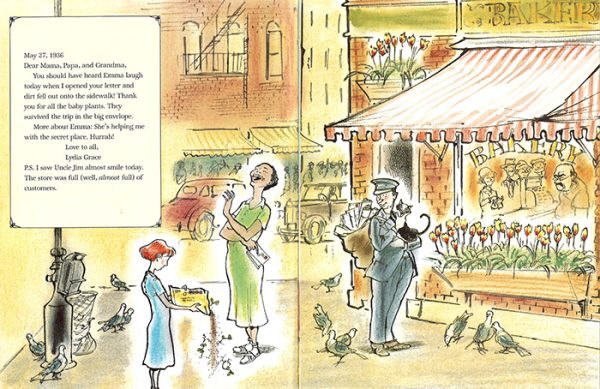
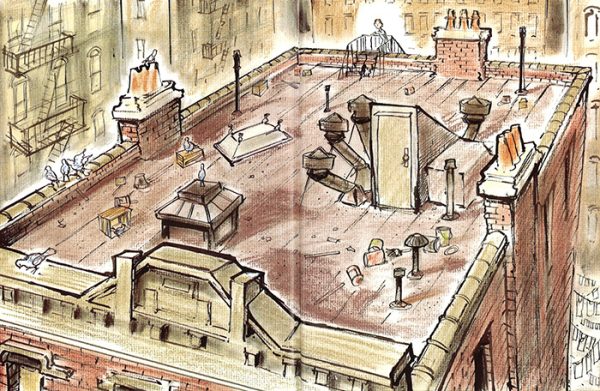
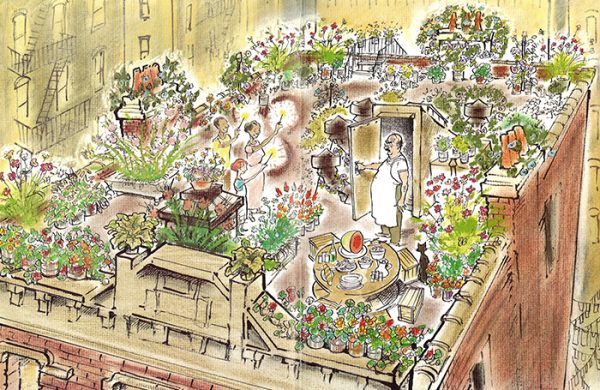
Lydia Grace reveals her “secret place” on the Fourth of July when she beckons her uncle to the flat rooftop of the three-story building, overflowing with containers of flowers and vegetables. In this space of unexpected color and delight, Uncle Jim’s characteristically stern demeanor is in stark contrast with the enthusiasm of adult friends Ed and Emma and Lydia Grace. While his gruffness never changes during her stay, the uncle shows his love for the girl with a splendid farewell cake when Lydia Grace is beckoned back home. In the tender wordless final scene, the forbidding train station where the girl arrived months earlier is now bathed in golden hues as Uncle Jim gives her a hug, Ed and Emma look on, and the former store cat peeks out from its travel carrier. The story is based on the childhood of the author’s gardener friend, also named Lydia Grace Finch. [6]
In this 1998 Caldecott Honor book, Small renders his loose illustrations in watercolor, ink pen line, and crayon [7] in a sophisticated cartoon style. With a few pen strokes, characters’ expressions carry much emotion. Small uses a palette of mostly pastel colors throughout the book in double-page, full-bleed spreads. Warm light cheers indoor scenes, while sunlight bathes the bakery neighborhood as Lydia Grace discovers an appreciation for her city home. In every spread, the young gardener is completely surrounded by a halo, emanating light even during trying times.
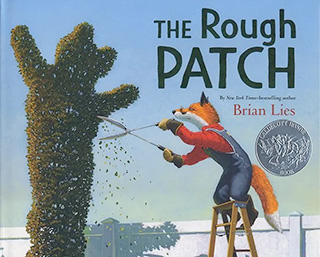
Another moving story that explores the garden as a place of joy and healing is The Rough Patch, a 2019 Caldecott Honor book written and illustrated by Brian Lies. Readers first meet Evan, an anthropomorphic fox donning overalls, and his dog in the garden, before learning all the other things they do together. “But what they loved the most was working in Evan’s magnificent garden.” Abruptly, “the unthinkable happened” when the dog dies.
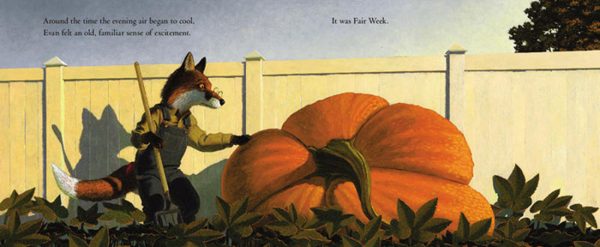
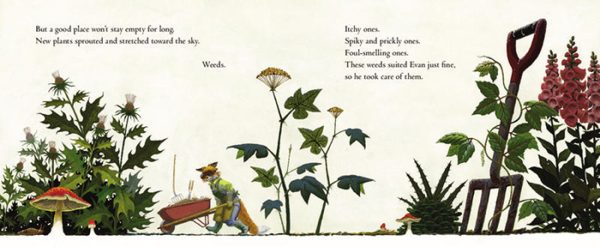
In his grief and fury, Evan destroys the garden and nurtures the weeds that move in. When a wandering vine creeps under the fence into his yard, Evan leaves it and finds himself caring for the lone squash that emerges. Ultimately, tending to what becomes an enormous pumpkin awakens Evan’s weary spirit and helps him reconnect to the rhythm of the growing season, fall traditions, and friends. The final wordless single-page illustration shows a new puppy in the passenger seat of Evan’s pick-up truck.
Lies deftly blends realistic and cartoon styles to create detailed illustrations with acrylics, oils, and colored pencils, [8] using deep, rich colors and playing with light, shadow, and perspective during the protagonist’s recovery from loss. Lies varies the page design, from saturated full-bleed double-page spreads to multiple vignettes on a spread, with transitional scenes on a vast white background. The author-illustrator considers the book “a meditation on grief and the anger which sometimes accompanies it … and on hope.” [9]
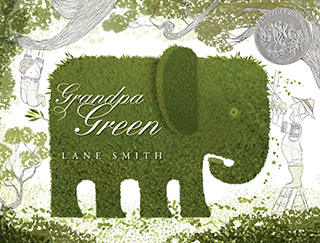
In a more understated manner, author-illustrator Lane Smith also considers relationships and loss in Grandpa Green, a 2012 Caldecott Honor book. Set in a topiary garden, a boy moves among the many living sculptures that convey significant moments of his great-grandfather’s life. Along the way, the boy picks up items left behind by the elder gardener who “sometimes forgets things.”
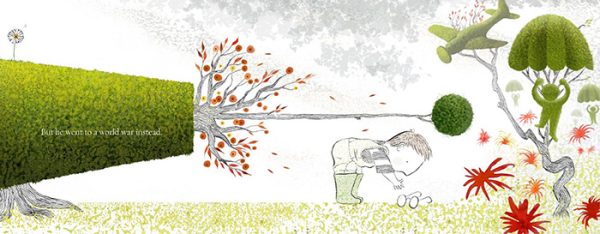
“But the important stuff, the garden remembers for him.” Humorous scenes are balanced with poignant ones: The tears of the newborn baby spring from a hidden hose, while topiary flames and a cannonball fly from a cannon in wartime. When the boy completes his tour, pulling a wagon filled with lost possessions, his great-grandfather has begun what might be his final tableau. A gatefold opens to the completed piece of the boy fighting a dragon, set amidst the other impressive topiary works introduced on the boy’s walk. The book ends with a wordless single-page spread showing the boy creating a topiary tribute to his great-grandfather. (click on the image below for a larger view)
Smith showcases a self-described “media extravaganza” [10] in his full-bleed cartoon and abstract illustrations. The humans and the objects retrieved by the boy are drawn in simple lines with a brush and waterproof drawing ink, colored with subtle green, brown, pink, and gold and placed against white backgrounds; tree trunks and branches are also drawn with ink. In contrast, the textured foliage, in various shades of green, is applied with techniques including a sponge dipped in watercolor; “oil-based paint and a lot of thinner … sprayed … with a water-based varnish” and blow-dried; [11] and digital paint. [12] Deep red is used judiciously in topiary scenes of illness, book characters, war, and love. Smith admits that the linework and limited color conveys “a strong 1970s vibe,” [13] lending a nostalgic feel to a multigenerational story.

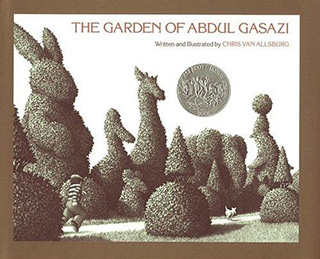
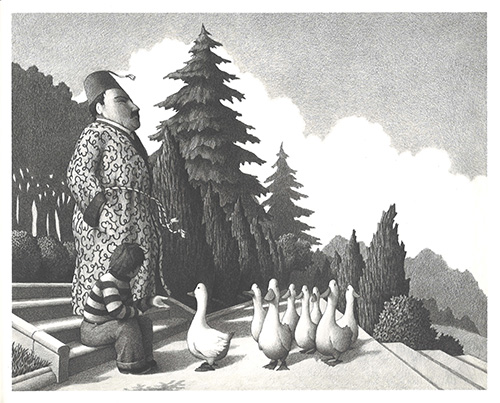
A topiary is also the setting of The Garden of Abdul Gasazi, the first book published by author-illustrator Chris Van Allsburg. In this 1980 Caldecott Honor book, Miss Hester asks Alan Mitz to watch her “bad-mannered dog” for an afternoon while she is away. On their walk, Fritz snaps out of his collar and dashes into the garden of Gasazi the Great, a retired magician. Here dogs are expressly forbidden.
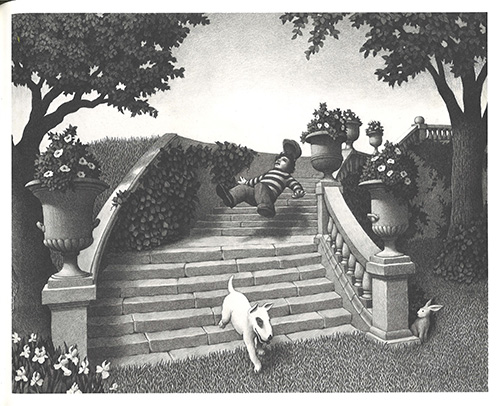
In his desperate search to find Fritz, the boy bravely approaches the magician, who claims that the dog has turned into a duck, one of a small flock on a terrace. The duration of the spell, he explains, “may last years or perhaps just a day.” The duck flies out of Alan’s arms before the boy leaves the grounds. When the disheartened boy returns to Miss Hester’s home, he is caught off-guard when the woman and the errant dog greet him. While the woman reassures Alan that “‘no one can really turn dogs into ducks,’” a clue on the final spread leads readers to think otherwise. The wiley bull terrier Fritz was a real dog named Winston, owned by the artist’s brother-in-law; in fact, the canine appears in some form in Van Allsburg’s subsequent books. [14]
Van Allsburg heightens the intrigue with realistic black and white illustrations that play with light and shadow. Carbon pencilwork on Strathmore paper [15] creates soft textures and an ominous mood as the artist blends reality and illusion. In the formal book design, single-page illustrations are placed on the recto (right), with text on the facing page enclosed in a decorative leaf border. In fact, plants or leaf and flower motifs appear in almost all images. Curiously, the fanciful topiary sculptures that grace the front book jacket are never seen in the book, giving readers another mystery to ponder.
Van Allsburg was an established sculptor when he began dabbling in drawing, which ultimately led to this book. He explains, “The story began with a single image of a boy pursuing a dog through a topiary garden. Asking and answering questions about this picture (Who is the boy? Where are he and the dog going? Whose garden are they in?) ended up revealing a story that dealt with the differences between stage magic (illusion) and genuine wizardry.” [16] Indeed, in all of his picture books (think of Jumanji or The Polar Express, for examples), the author-illustrator continues to delve into the realm of the unexpected and extraordinary.
In these Caldecott Honor books, the garden settings are central to the story lines. Whether vegetables, flowers, or sculpted shrubs and trees, gardens offer a place to cultivate creativity, healing, and awe.
Picture Books Cited
Lies, Brian. The Rough Patch. Greenwillow, 2018.
Smith, Lane. Grandpa Green. Roaring Brook, 2011.
Stevens, Janet. Tops & Bottoms. Clarion, 1995.
Stewart, Sarah. The Gardener. Illustrated by David Small. Farrar Straus Giroux, 1997.
Van Allsburg, Chris. The Garden of Abdul Gasazi. Houghton Mifflin, 1979.
Notes
- Lisa Wimmer, “Dig into the Benefits of Gardening,” Living Well, Mayo Clinic Press, 29 February 2024.
- “Why Garden with Kids?” About Us, KidsGardening, Accessed 15 March 2026.
- Janet Stevens, Tops & Bottoms (Clarion, 1995), jacket.
- Carolyn S. Brodie, “Janet Stevens: Picture Book Artist and Reteller,” School Library Media Activities Monthly 15, no. 7 (March 1999): 45.
- Janet Stevens, Tops & Bottoms (Clarion, 1995), copyright page.
- Kathy Temean, “Illustrator Saturday – David Small,” Writing and Illustrating: Sharing Information About Writing and Illustrating for Children (blog), 16 August 2014.
- Association for Library Service to Children (ALSC), The Newbery & Caldecott Awards: A Guide to the Medal and Honor Books (American Library Association, 2020), 118.
- Brian Lies, The Rough Patch (Greenwillow, 2018), copyright page.
- Brian Lies, “Frequently Asked Questions,” Brian Lies: Children’s Book Author and Illustrator, Brian Lies: Children’s Book Author and Illustrator, accessed 15 March 2026.
- Jennifer M. Brown, “A Garden of Memories,” School Library Journal – Curriculum Connections. Media Source, Inc. August 2, 2011.
- Brown, “A Garden of Memories.”
- Lane Smith, Grandpa Green (Roaring Brook, 2011), copyright page.
- Burgin Streetman, “Meet Lane Smith: Part Two,” Vintage Kids’ Books My Kids Love (blog), 2 October 2011.
- Chris Van Allsburg, “Frequently Asked Questions,” Chris Van Allsburg, Chris Van Allsburg, accessed 15 March 2026.
- ALSC, Newbery & Caldecott Awards, 133.
- G. Wayne Miller, “Q & A with Lisa and Chris Van Allsburg,” Ocean State Stories, Ocean State Stories, 17 October 2024.
Bibliography
Association for Library Service to Children (ALSC). The Newbery & Caldecott Awards: A Guide to the Medal and Honor Books. American Library Association, 2020.
Brodie, Carolyn S. “Janet Stevens: Picture Book Artist and Reteller.” School Library Media Activities Monthly 15, no. 7 (March 1999): 45 – 47, 50.
Brown, Jennifer M. “A Garden of Memories,” School Library Journal – Curriculum Connections. Media Source, Inc. 2 August 2011.
Lies, Brian. “Frequently Asked Questions.” Brian Lies: Children’s Book Author and Illustrator. Brian Lies: Children’s Book Author and Illustrator. Accessed 15 March 2026.
Lies, Brian. The Rough Patch. Greenwillow, 2018.
Miller, G. Wayne. “Q & A with Lisa and Chris Van Allsburg.” Ocean State Stories. Ocean State Stories. 17 October 2024.
Smith, Lane. Grandpa Green. Roaring Brook, 2011.
Stevens, Janet. Tops & Bottoms. Boston: Clarion, 1995.
Streetman, Burgin. “Meet Lane Smith: Part Two.” Vintage Kids’ Books My Kids Love (blog). 2 October 2011.
Temean, Kathy. “Illustrator Saturday – David Small.” Writing and Illustrating: Sharing Information About Writing and Illustrating for Children (blog). 16 August 2014.
Van Allsburg, Chris. “Frequently Asked Questions.” Chris Van Allsburg. Chris Van Allsburg. Accessed 15 March 2026.
“Why Garden with Kids?” About Us. KidsGardening. Accessed 15 March 2026.
Wimmer, Lisa. “Dig into the Benefits of Gardening.” Living Well. Mayo Clinic Press. 29 February 2024.


SUCH a great collection! A couple are new to me, but I’ve already got them on my library request. Thanks!