Reading Picture Books Even Though You Are No Longer a Little Kid
Getting on the Bus
I have checked out from the library Loren Long’s picture book The Yellow Bus so many times, the library ought to give it to me. The Yellow Bus came out in 2024. I am 72 and am still checking it out from our library. Why? Why does a children’s picture book have so much pull on me, a senior? Because I’ve never stopped reading and loving picture books.
I read them for different reasons. One, I’m a children’s book writer and I read picture books to study the form. In fact, that’s how I learned to write picture books. In the summer of 1981, I decided I wanted to write more than middle grade and young adult novels. I had stories in my head that required a shorter format.
Each week that summer, I went to the public library and checked out twenty-five picture books. I sat down with them at home and read all twenty-five. Then I re-read them, this time dividing them into two piles. One stack were the books I knew I could never write — zany, silly, highly imaginative. That’s just not my mindset. The second stack contained quiet, atmospheric, lyrical picture books. Those I could do. Next, I gathered the second stack and typed out some of the stories to separate the text from the art. That allowed me to see the skeleton of the manuscript.
By the end of the summer, I had checked out, read, studied, and in many cases typed out the texts of five hundred picture books. That summer served as my conference on writing picture books, my series of webinars, my MFA. My education. It worked. After nearly 190 published children’s books, including picture books, I still type out the texts of certain picture books.
Another reason I read picture books as an adult is because I am an instructor of an MFA graduate program in writing children’s books at Hollins University. I read picture books to stay current in the field. I owe it to my students to read what they might be reading and if they aren’t keeping up with picture books, I can guide them to the best.
The last reason is more personal. I read picture books for myself. After a long day of writing for children, I take picture books to bed. Hours of writing often leaves a writer wondering if she’s on the right path, if she’s uncertain about a project that might likely be scrapped and started over the next day. A picture book is a whole thing, a finished story. They are easy to read, with a bonus of pictures. What’s not to love?
Connecting to Your Inner Kid
Gregory Walters, like me, has no children. However, unlike me, he was a former elementary school teacher and then principal who has read aloud “hundreds, if not thousands” of picture books to students. When Walters retired, he decided to catch up on all those important adult books he’s missed. All that heavy reading with weighty agendas sent him back to picture books.
“Typically 32 pages and under a thousand words, picture books offer a quick read and a longer gaze,” Walters remarks. “They have evolved, becoming more varied in terms of art and subject matter since I was a child …” Many adults who have read to their own children or remember from their childhoods some of the books Walters loved — Curious George, Dr. Suess, and P.D. Eastman’s Are You My Mother?
As a grown-up, Walters appreciates new classics like Dragons Love Tacos right alongside Blueberries for Sal. “The art in works of Loren Long, Elisha Cooper, Marie-Louise Gay and Chris Van Allsburg dazzles me,” he says, echoing my own feeling that we adults value the vast styles and richness of fine illustrations. Best of all, he believes, “Sometimes a picture book night beats anything on Netflix.” Amen.
I came to picture books at an odd age. I never attended nursery school or went to kindergarten, typically places where young children are exposed to the wonders of picture books. I had no picture books at home. I never saw the inside of a library until I started first grade at Centreville Elementary with its tiny school library. Kids first through third grade were relegated to a single bookcase of age-appropriate books. Fourth through sixth graders could browse through three walls of books. I’m sure my first and second grade teachers read picture books to the class. Certainly the school librarian, the exotic Miss Sharp who wore her thick black hair in a bun and a slash of red lipstick, must have held story hour.
Afterward we were free to browse and check out books from our restricted bookcase. I remember taking out Curious George and Sam the Firefly by P.D. Eastman. By third grade, though, I was chafing to explore the big kids’ shelves. I remember sneak-reading some of those books during our library period, reluctantly putting them back behind the stacks so I could retrieve the same book the following week.
So, I sort of skipped picture books. I read Goodnight Moon and Harold and the Purple Crayon as an adult. The summer I read five hundred picture books, I felt as if I’d stumbled into Ali Baba’s cave. Where had all these jewels been hiding? Smart picture book lovers keep their books in plain sight.
Jamie Canaves preserves his childhood picture books in his office. Even though he stores them there, he stopped reading picture books, believing he had “aged out of them.” In his thirties, he returned to reading young adult and middle grade novels. At the beginning of 2022, he decided to read one picture book a week. He chose them by their covers (I used to buy children’s books simply for their covers by illustrators Trina Schart Hyman and Fred Marcellino).
Yet Canaves soon found that parceling out his picture book selections to only once a week was not enough. He grabbed picture books at the library “when I needed a destresser, or a pick-me-up, or just a quick escape.” If you don’t have children or grandchildren and you feel you are too old to read picture books, you are missing their best attribute: they are soothing. And heaven knows, most of us adults need all the soothing we can get.
I know from visiting elementary schools many of the kids appear anxious. I know from my twenty-something great-nieces and ‑nephews they are very anxious about the world they are entering as adults. In Beyond Anxiety by sociologist Martha Beck, we can blame the artificial world we’ve created as humans from the Industrial Age to the present. “We force our bodies to run on clock time,” Beck says, “rather than in accordance with the seasons, our states of health, or physical sensations like hunger, thirst, or fatigue.”
That world changed our brains. The now-dominant left hemispheres of our brains “likes things man-made.” The left hemisphere’s “preferred tools: force, logic, and control … It focuses overwhelmingly on one single goal: maximizing material wealth.”
To quote Beck, “This is why Amazon’s founder, Jeff Bezos, one of the wealthiest human beings in history, wrote to his stockholders, ‘I constantly remind our employees to be afraid, to wake up every morning terrified.’ Living in fear, he asserts, is the way to stay ahead.” Great for him, not so much for the rest of the anxiety-riddled population. Anxiety fuels our economy.
The antidote according to Beck: try to find our creative selves or at the very least, step back from our culture of “grabbing stuff.”
Jamie Canaves discovered picture books are a stress reliever through the illustrations. “Unlock your creative brain and let the images expand in your mind,” he advises. “Take the time to spot every detail. Appreciate the use of color, or lack of … Be curious for a moment.”
It seems such a small thing, but picture books allow us to release anxiety and relax.
Getting Back on the Bus
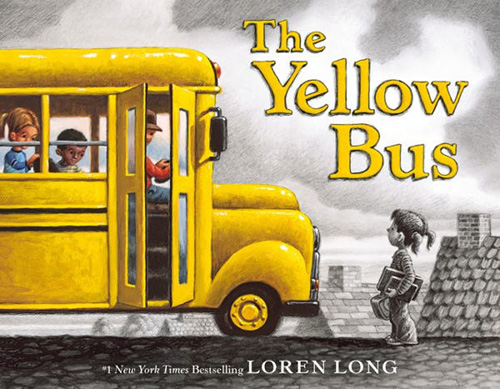
The Yellow Bus is an astonishing picture book. I’ve read it multiple times because I’m in a different place each time I check it out from the library. I could buy this book for my collection, but my inner child wants it from the library. The dust jacket is encased in a cellophane wrapper, protecting it. I feel a sense of connectedness with the library book, a passing down from other children who have checked it out and read it or had it read to them. It begins:
There was once a bright yellow bus
who spent her days driving.
Every morning they climbed in …
pitter-patter, pitter-patter, giggle, giggle-patter.
A school bus ferries children to school, its usual job, one that fills the bus with joy. Years later, it begins a new life carrying senior citizens to the library and other places. Later yet, the bus is abandoned and is no longer filled with joy. There’s much more. As an adult, please give yourself the gift of reading this book. It’s about things we understand most, the passage of time and the need to be useful.
The book itself is an incredible production. Long’s text is brief, but the art contains a story as big as the universe. The story behind the story is worth knowing. He created the illustrations in acrylics and charcoal dust. The story behind the illustrations will make your jaw drop. Two pages of back matter on the creation of this book will fill you in. Sources at the end of this essay include an interview months before the book was published that gives more information and a YouTube video that shows Long’s journey with this beloved bus.
As soon as the book hit our library shelves, I checked it out. And then again when my husband was diagnosed with Stage 4 cancer. I read it to him, showing him how the art depicted time passing and the stages of the yellow bus’s lives. Months later I read it to him when he had to quit working at a job he enjoyed because he was 90, because he had cancer and, mainly, because Corporate decided he was no longer needed.
I took the book out of the library again today. As I wrote this, my husband was 91 and nearing the end of his journey. I read him Loren Long’s wonderful picture book once more before the yellow bus came for him and he got on.
Sources
Beck, Martha. Beyond Anxiety: Curiosity, Creativity, and Finding Your Life’s Purpose. New York: Penguin Random House, 2025.
Bird, Betsy. “BB + LL: An Interview with Loren Long On His Upcoming Book, The Yellow Bus.” School Library Journal. 2 Nov. 2023.
Canaves, Jamie. “You’re Missing Out As An Adult If You Don’t Read Picture Books.” Book Riot. 2 June 2022.
Long, Loren. The Yellow Bus. New York: Roaring Brook Press, 2024.
“The Making of THE YELLOW BUS by Loren Long.” MacKids Books. YouTube.
Walters, Gregory. “Why I Read Picture Books … for Myself.” 7 Feb. 2025. Next Avenue.
What a beautiful essay. Your summer of 500 picture books is a masterclass of writing that any of us can enroll in. I’ve never stopped reading picture books, but I think I will increase my consumption, especially during these long days of summer. And you’re right, THE YELLOW BUS is a marvel.
Thank you, David. I wrote that essay while nearing the end with my husband. I needed sleep back then, but I needed more to write about something close to my heart. I tell all my graduate students about that summer. Back then, there were no MFA programs for children’s books, not even any books on how to write them. I subscribe to the DIY MFA for learning any new format or genre. After 45 years in the industry, I still do it myself.
Thanks for reading and commenting!
What a beautiful essay — on books and life. I also appreciate the reminder to savor the illustrations. I’m a “words” person but when my kiddos were young, they helped me tune in to the illustrations in ways that I might never have done on my own. That’s just part of the reason I still look for opportunities to read with bright young learners.