
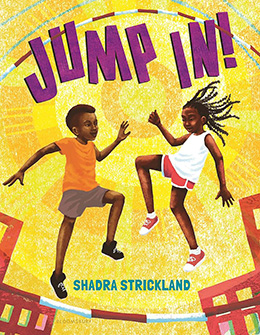
In Jump In, written and illustrated by Shadra Strickland there is joy in the street as kids come out for double Dutch jump rope. “Grab two ropes. Make a loop. /Everyone line up. Jump through the hoop! / Two becomes four. Four more is eight. / Rock back-and-forth. Don’t hesitate. /” First come the Delancy twins. “Sisters of the sidewalk, we jump in twos, / clapping our hands to the Double Dutch blues.” Then Leroy “…I got moves you ain’t seen yet.” Leroy can’t be contained on a two-page spread. He gets a fold out for his leaps and bounds. And so does Ms. Mabel and her “funky wiggle.” And the Reverend gets a lift up for his high-in-the-air jump. But the best comes toward the end when so many kids jump in that it takes two fold outs, a double, double page spread to contain the joy.
Turning, lifting, unfolding the pages is part of the fun. So is the rollicking, rhyming language. We all will want to grab jump ropes and go out into the street when we finish reading this book.
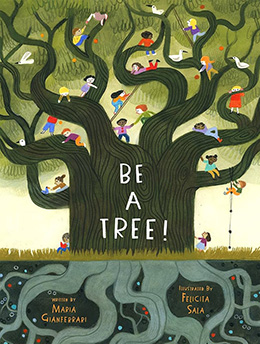
Be a Tree!, written by Maria Gianferrari and illustrated by Felicita Sala, invites readers to “Be a tree! /Stand tall. /Stretch your branches to the sun. /Let your roots curl, /coil in the soil to ground you.” The book is a lyrical examination of the parallels between child reader and tree— “In your heart’s center/is your pith, /keeper of nutrients/when you were a sapling.” On that spread we see the pith of a tree trunk on one side and silhouette of a child’s body on the other connected by swaths of color filled with small circles of nutrients.
Trees exist in community, “Our roots/twine with fungi, / joining all trees /in the forest together.” And we humans do, too, “We talk, /share food, /store water, / divide resources, / alert each other/ to danger.”
Perhaps the most important section of the book gets a double double page spread “…together,/ a forest of trees is strong. /Mother trees nurse young trees. /Old trees shade new trees. /Strong trees shelter weak trees. / Healthy trees help sick trees.” That is what we can all learn from trees. And the book reminds us, “So, be a tree. /For together, /we are a forest.”
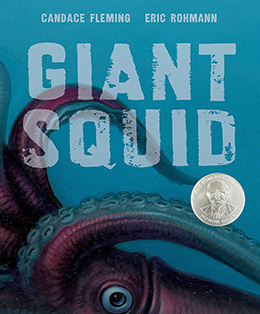
Fold-outs are wonderful surprises in information picture books, too. There is only one fold-out in Giant Squid, written by Candace Fleming, illustrated by Eric Rohmer, but it is perfectly placed. In this beautiful book we learn that giant squids have 30-foot long tentacles, studded with suckers, a beak like a parrot, a tongue studded with tiny blades, and one eye, big as a soccer ball. They can change color, sometimes pinkish purple, sometimes pale yellow or silver gray, red with brown They are truly terrifying. Yet the just hatched squid babies are only two inches long and vulnerable to many ocean predators. Just when we think one of those babies is about to be captured — squid ink!
We see neither predator nor prey, just a cloud of ink. And the next double double reveals the whole of the giant squid — the first time in the book we have seen the whole animal. Fleming’s poetic, rhythmical language and Rohmer’s beautiful illustrations make this an unforgettable book about an astonishing creature.