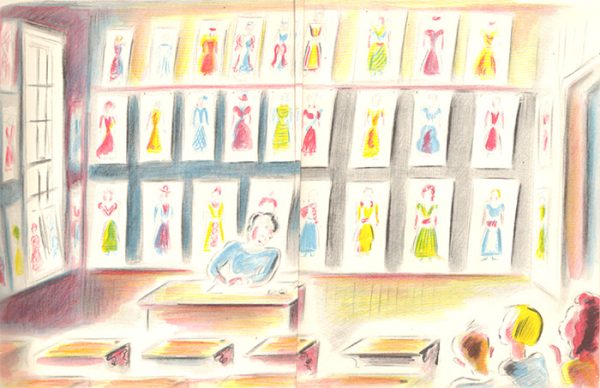
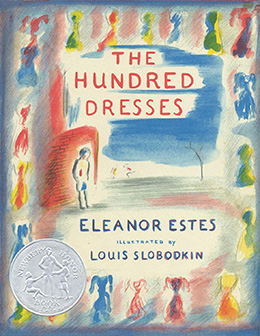
Crow Boy by Taro Yashima and A Hundred Dresses by Eleanor Estes are modern classics. Published over fifty years ago, neither has been out of print to date and both continue to be widely read. Books of conscience, with strong moral content, these are about poverty, outsiders, bullying, and bystanders: issues as pertinent today as when these books were created. Told from the point of view of a child who witnessed the mistreatment of another, joined in, and did nothing to stop or alleviate it, these are stories of remorse.
Of the many choices a writer makes, a key decision is when to begin the story. In The Hundred Dresses, at the beginning of the story, a central character is missing: “Today, Monday, Wanda Petronski was not in her seat.” Wanda never reappears. Her family has moved to the city, away from the prejudice of the small town: “No more holler Polack. No more ask why funny name.” The story concerns the things that were done to Wanda by classmates before the story begins and the remorse felt by Maddie, a reluctant participant in the teasing.
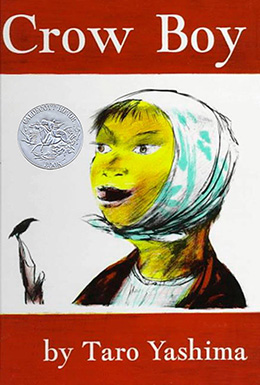
Crow Boy begins with the first appearance of Chibi: “On the first day of our village school in Japan, there was a boy missing. He was found hidden away in the dark space underneath the schoolhouse floor.” The narrator is a classmate and the story spans the six years spent together in the village school. Although the use of time differs in these books, both are concerned with events remembered, with actions that cannot be undone.
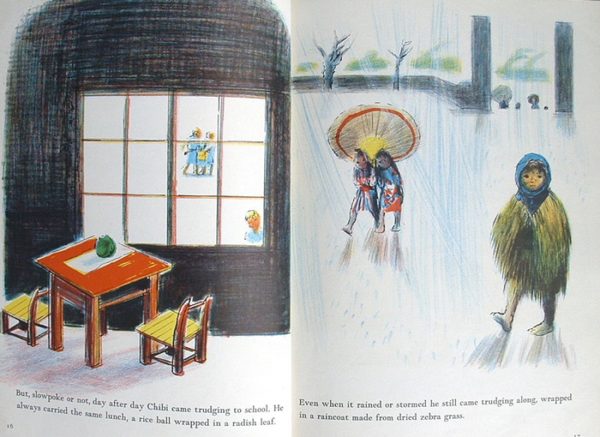
Chibi and Wanda Petronski are outsiders, children marked by poverty. They live on the outskirts of town. Even their clothes set them apart. “Wanda didn’t have any friends. She came to school alone and went home alone. She always wore a faded blue dress that didn’t hang right. It was clean, but it looked as though it had never been ironed properly.” Chibi “was left alone in the study time. He was left alone in the play time … A forlorn little tag-along.” He “always carried the same lunch, a rice ball wrapped in a radish leaf. Even when it rained or stormed he still came trudging along, wrapped in a raincoat made from dried zebra grass.”
Chibi, frozen by fear and unable to learn, is soon taunted: “ … not only the children in our class but the older ones and even the younger ones called him stupid and slowpoke.” Wanda, too, is taunted, but more subtly, by the girls in her class who bait her to talk about the clothes she claims to have at home — the hundred dresses. “They often waited for Wanda Petronski — to have fun with her.” The wording here is knife sharp — to have fun with her, like cats playing with a doomed mouse.
We learn about Wanda from the remembrances of Maddie, whose friend Peggy led the attacks. The decision to begin the story after Wanda has moved away magnifies Maddie’s guilt over their treatment of Wanda. The teasing has already occurred. If Wanda was present, it would have continued: before they learn that she has moved, the girls wait on the usual corner hoping to entrap Wanda again. The teasing stops only because Wanda does not appear. The decision to begin the story here leaves room for the exploration of Maddie’s conscience. Peggy, the instigator, is less affected by guilt. She provides an excellent contrast, able to justify her mistreatment: “What did the girl want to go and say she had a hundred dresses for? … Why did she want to lie? And she wasn’t just an ordinary person, else why would she have a name like that? Anyway, they never made her cry.”
Maddie’s unwillingness to interrupt the teasing stems from fear that Peggy might turn on her next. “But suppose Peggy and the others started in on her next? She wasn’t as poor as Wanda perhaps, but she was poor.” Uneasy during the teasing, Maddie is filled with remorse as she remembers her inaction. She fantasizes scenes in which she defends Wanda: “‘Stop! This girl is just a girl just like you are….’” She visits Wanda’s house hoping to make amends but the house is vacant. With Peggy, she writes Wanda a letter. “They had meant to say they were sorry, but it ended up with their just writing a friendly letter, the kind they would have written to any good friend, and they signed it with lots of X’s for love.”
Wanda and Chibi do not retaliate. Possibly Wanda does not understand the subtlety of Peggy’s mocking or perhaps her loneliness pushes her to talk to the girls. Chibi withdraws into his own world which Yashima depicts in words and pictures. Both children use imagination to escape their narrow and lonely lives. “Soon Chibi began to make his eyes cross-eyed so that he was not able to see whatever he did not want to see.” (The illustrations show children mocking him.) He finds things to interest him in the classroom and outside: patterns, sounds, insects, birds. Wanda creates the hundred dresses, drawings that she sends back to the school; she wins the medal for art but she is not there to receive it.
The change in both books occurs in the attitude of the children towards these outsiders. In Crow Boy, a new teacher, Mr. Isobe, takes an interest in Chibi and discovers his many gifts: the drawings he makes of nature, the unique handwriting he has invented, his knowledge of plants. Chibi performs in the talent show, imitating the voices of crows. “Everyone’s mind was taken to the far mountainside from which Chibi probably came to school. … Every one of us cried, thinking how much we had been wrong to Chibi all these long years.”
The final actions of both — Wanda’s hundred dresses, and her gift of drawings to the ringleaders of the teasing girls, and Chibi’s imitation of crows at the talent show — reveal who they have been all along. Chibi captures his long, lonely walk and the tiny farm where he lives. Wanda’s gift, the outpouring of her imagination, shows a wealth of creativity that her classmates never suspected. These gifts change the perceptions of their classmates and teachers.
Crow Boy ends happily. The children no longer call him Chibi, or tiny boy. Now when he comes to the market, they respectfully call him Crow Boy and he responds with a happy crow call. The dismissive nickname is replaced with one of admiration. It is a positive ending, a full resolution.
But in The Hundred Dresses no such resolution is achieved. Peggy is able to convince herself that Wanda’s gift of a portrait means all is forgiven: “‘What did I say! … She must have really liked us’.” But Maddie is not convinced and, unable to forget her participation in the teasing, she cries when she remembers Wanda “standing alone in that sunny spot in the school yard close to the wall, looking stolidly over at the group of laughing girls.” The Hundred Dresses ends with Maddie’s conscience still troubled, her pain acute.
Crow Boy and The Hundred Dresses expose the suffering of the outsider, the cruelty of bullies, and appropriate remorse which ends in atonement. As with the best of stories, these leave it to readers to draw conclusions and ponder the applications to our own lives.
WORKS CITED
Estes, Eleanor. The Hundred Dresses. New York: Harcourt, 1944.
Murphy, Kate. “Maya Angelou,” New York Times. 20 April 2013. Web 2 Apr 2016.
Yashima, Taro. Crow Boy. New York: Viking, 1955.


This was a poignant article. Thank you. Even though the copyrights are long ago, I hope these books continue to be shared with children today.
They are so timeless. I also hope they will stay in print. Sometimes the medals help.
These two books have so much to teach children – and the world – today. I hope they never go out of print. In fact, I would love to see an anniversary edition of Crow Boy, originally published in 1955.
Having the medals help books stay in print. An anniversary edition –full size – would be wonderful
Thank you for this essay, Christine. You are right. These books are classics and deserved to be read by all of us, more than once.
Jackie, they both hold up so well. I was struck by the craft in The Hundred Dresses– the difference in the two girls, the absence of Wanda. Her absence adds so much to the story.
Each Kindness by Jacqueline Woodson is another book to use with these two.
What a good suggestion. Thank you.