
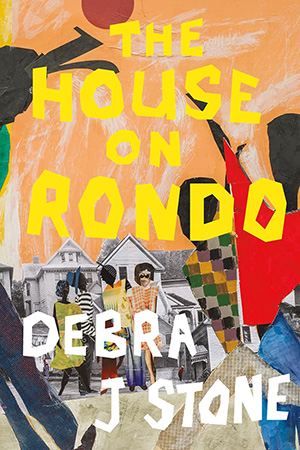
If someone from the government came to your house and said, “You’ll have to abandon this house. We’re going to tear down your neighborhood and put a major highway through here.”
How would you feel?
What plans would you put in place to thwart the house you cherish from being destroyed?
This is a book filled with love. Zenobia, a thirteen-year-old, is staying with her mother’s parents for the summer. Zenobia’s family lives in north Minneapolis and her mom’s parents live in Saint Paul, so her grandparents are relatively close. But in the early 1960s, with a father who works three jobs, and a mother who is undergoing physical therapy to overcome a stroke, being with her grandparents feels very far away.
Zenobia loves Grandma Essie and Grandpa Joe but it’s hard to be away from her friends. Her younger siblings, Mookie and Frannie, seem to adapt easily to a summer away. When Zenobia gains a new girlfriend in Rondo and begins to learn more about the people who live there, Zenobia finds new reasons to care, to be involved, to protest, to express how much she loves these neighbors.
I’ve been thinking about this book ever since I read it several weeks ago. It’s one of those books I will always remember. Debra J. Stone’s storytelling is captivating.
The characters, the way they cared for each other in the Rondo neighborhood: Ruby Pearl, the retired cowgirl, the “Black Annie Oakley;” Margaret, who can’t take care of her daughter Betty because her need for alcohol overtakes her; Miss Milton, who provides a foster home for children who have been abused and abandoned.
Even the house speaks up:
“On a hill on Rondo Avenue, in the heart of the Negro district of Saint Paul, I was the home of Grandma Essie and Grandpa Joe Price. I sat atop the hill on the Avenue where neighborhood businesses bustled with activity: grocery stores, barber shops, hair salons, and the lawyer’s office. There were several restaurants and the VFW Club that on Saturdays played music for dancing throughout the night.”
“Two days after the Jacksons were forced by eminent domain to leave their home, it was moved three blocks to Dayton Avenue. Did the Jacksons know? They understood the house was to be demolished. Who moved it? The people of Rondo knew who decided. It was the people downtown.”
This is a work of fiction, but it is also a well-researched story of a neighborhood the author experienced. Her grandparents lived in the house at 841 Rondo Avenue from 1941 to 1963 when it was razed to make room for Interstate Highway 94. Like many communities throughout America, primarily communities Black people called home, the Rondo neighborhood was taken by eminent domain. There is a lengthy list of those neighborhoods in the book – my heart aches.
It is a book filled with love. Community. Neighbors. People who care for each other. It is a book I encourage you to read.
I have friends who live on Iglehart, one block south from Rondo, and the street to which Grandma Essie and Grandpa Joe relocated. I will never see that street again without thinking of all the people who found new homes there in the ‘60s, all the while missing their old neighborhood.
I couldn’t resist researching more about Rondo. When you read the book, look up these articles and websites for pictures and memories.
In 2024, a two-mile stretch of Concordia Avenue was renamed Rondo Avenue in honor of the old neighborhood.
When the new Rondo street signs were installed, activist Marvin Roger Anderson said, “What’s in a name for us? You see the word Rondo up there. And you think of all of the people who’ve struggled on this street, to create a better life to live an American life,” he said. “They lived on Rondo, this was a community that we felt so completely whole in. We wanted to begin healing because it’s a wonderful feeling. Now we have the name back.” (Peter Cox, MPR News, 30 April 2024)
Thank you for the link, Vicki. The photos were some of the same ones I saw at the outdoor display in the Rondo area. Photos of actual people and actual buildings make the destruction of a community all the more real, and heartbreaking.