
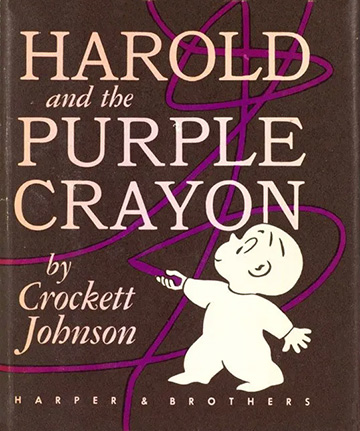
 No one knows for sure if Crockett Johnson had studied Klee’s Pedagogical Sketchbook (translated into English in 1953). Klee’s book opens with, “An active line on a walk … a walk for walk’s sake. Johnson’s Harold and the Purple Crayon (1955) opens with, “One evening, after thinking it over for some time, Harold decided to go for a walk in the moonlight.”
Harold holds a purple crayon that he has used to scribble on the facing page. He wears a thoughtful expression. There is no moon so he draws a waning crescent, then a path, and off he goes. This deceptively simple book was a ground-breaker. But “this was Johnson’s aim and his bane,” Philip Nel states in his critical text, How to Draw the World: Harold and the Purple Crayon and the Making of a Children’s Classic. Johnson’s design and text are anything but simple. Nel believes “the invisibility of [Johnson’s] artifice is precisely what makes the book so powerful.”
Harold’s walk, really a cause-and-effect journey, is one long picture if you cut the pages and tape them together (don’t do this!). I read this book as an adult and was struck by the invitation it extended to children to draw their own story. Virginia Haviland’s 1955 review in The Horn Book declared, “This is a little book that will be loved, for Crockett Johnson’s wide-eyed little boy and his simple lines in purple crayon are the kind of illustration to stimulate the imagination. They will suggest similar drawing adventures.” In fact, many children picked up a crayon and drew in the liberal white space on the book’s pages.
When I was about 9 and still short of paper, I sat on the basement steps about midway down where there was a wide expanse of white-washed drywall. With a pencil, I made little drawings: cats, witches, horses, ghosts, whatever flowed from my pencil point. My mother was peeved, but my stepfather said nobody went down our basement anyway. I was permitted to draw to my heart’s content. Over the years, I covered the entire wall, as far as I could reach. When I left home, and then went back, I was dismayed to see my childhood mural had been painted over.
But not everyone contends Harold is about following your imagination. In his Literary Hub essay, Ross Ellenhorn says the book is about nonconformism as well as freeing a child’s creativity. The mid-fifties, when Harold was published, when McDonald’s opened, when consumer product advertising bombarded television, and when people fled cities for cookie-cutter houses in sprawling suburbs that had destroyed farms and forest, defined the new world of standardization.
“As the forces of consumerism threatened to consume us … Harold allied himself with the resistance instead,” says Ellenhorn. “Harold … was very much a proponent of our right to be original.” Ellenhorn learned a key lesson from Harold and the Purple Crayon: “Johnson showed me a way forward that had less to do with finding my way, and everything to do with getting lost in the art of making a life.”
Once a child has begun to purposefully draw images, she has mastered symbolic thinking. She understands lines on paper can be a symbol of something else — cat, tree, house. A single crayon can let her create her own world.
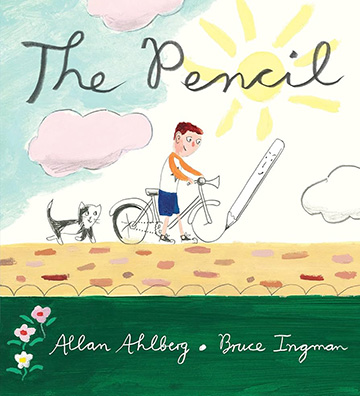 Kirkus describes The Pencil (2008) as a “distant cousin to Harold and the Purple Crayon … when a lonely pencil draws a smiling boy and names him ‘Banjo.’” Banjo wants a dog and the dog wants a cat to chase, which the pencil obligingly draws. The list of requests grows — demanding a name, even the dog’s ball (Sebastian) — and then they want to be in color. The pencil draws a paintbrush (Kitty) who splashes color on the characters and settings. But the characters aren’t happy with the way they look and threaten to rebel. Frantic, the pencil draws an eraser … and then must face the consequence of that action.
The story is hilarious but Bruce Ingman’s childlike art steals the show. Kids identify with his characters that are sometimes partly-finished as the pencil is still in the process of drawing. Austrian-born children’s book illustrator Bettina Ehrlich reinforces Ingman’s choice of everyday subjects. She wrote, “The small child paints and draws to express his thoughts and wishes and not from the desire to reproduce the visible world around him. He usually paints objects which he loves. Mum and Dad and little self before the house.”
As a young boy, Bruce’s hearing problem meant long stays in a hospital. He drew as a pastime and as a form of communication. After studying fine art in college, he decided to be a painter, “concentrating on large, narrative, autobiographical paintings.” Then he changed direction to became an illustrator.
“I came to this work with too much artistic baggage,” he says in an interview with The Guardian. “I had to learn to trust my instinct, to throw out what was unnecessary … Suddenly I felt free to express feelings directly with colour and design, free to simplify the drawing process … ”
The Pencil “explores the imaginative possibilities of the picture book in its purest form. A pencil is a familiar and very potent symbol of creativity, a natural extension of the imagination and this story … ”
Reviewer Travis Jonker wrote: “Many of the picture books I read are firmly ‘of the times’ — characters, dialog, and illustrations all combine to declare modernity. I envision kids reading these books for a few years and then, well, I’m not sure. Much more rarely do I encounter books that successfully rise above the here and now … “The Pencil” … should be a read-aloud hit.” It’s also a book for adults, who these days need to laugh at something besides kitten videos.
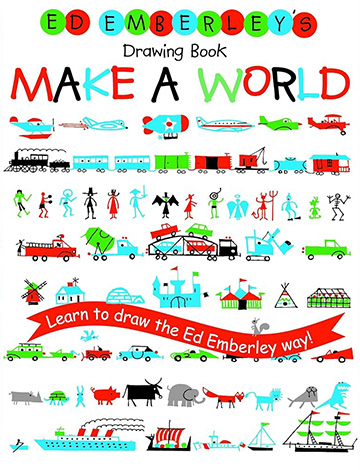 Children who grew up in the 70s and 80s may remember a series of step-by-step drawing books of everyday objects created by a combination of a few letters, numbers, and basic shapes. This book, and all the Emberley drawing books that followed, are still in print. they were given the mastery to draw anything in the book.
Ed Emberley was born in Cambridge, Massachusetts. His father, a carpenter, sometimes painted signs. Ed observed how his father drew letters using a grid. The grid seemed a handy tool. When Emberley finished art school, he went into advertising art, a job he hated. “The audience was in the trash can,” he remarked. He quit to create children’s books.
Each of his books was done in a different medium or technique: pen and ink, woodcuts, screen prints, pencil, even letterpress. Easily bored, Emberley also designed his books. Anita Silvey noted that “Emberley chose to create a unified consistently striking work rather than a few dazzling pages.”
But most of his books went out of print quickly, even after he won the 1968 Caldecott Medal for Drummer Hoff. Hoping to reverse that trend, in 1970 he produced The Drawing Book of Animals. Kids followed simple instructions based on the “key” of numbers, letters, and shapes such as parallel lines, dots, scribbles, and triangles to draw, say, an elephant. After learning to draw all the animals, kids could then make entire worlds of animals by adding (from the drawing book) jungle trees and lagoons.
Nowhere in Ed Emberley’s Drawing Book Make a World, the book I selected for this essay, does Emberley urge young readers to become artists. In Caleb Neelon’s essay/interview, “Keeping Up with Ed Emberley, he quotes Emberley’s philosophy, “Not everyone needs to be an artist, but everyone needs to feel good about themselves. Kids get swept away by their drawings … They’re making a world.”
Yet many of those who used Emberley’s drawing books did become artists. “A generation of adult artists now look back and realize Emberley’s drawing books were crucial to their own artistic development as children,” Neelon states. “Emberley never thought of himself as an art educator, and had worried his first drawing book landed at a time when copying was out of favor with pop culture.”
The books show ways to draw, not be an artist. Nowhere in those drawing books do the words “art” or “artist” appear. Emberley told kids at school visits that he drew pictures for a living.
“Kids get swept away by their drawings,” he said to Neelon. “They’re there. They’re making a world.”
All three of the books in this essay inspire action for kids today to get off screens and create. They don’t require expensive art classes. All they need is a crayon, or pencil and paper, or easy-to-follow instructions to master everyday objects and make a world of their own.