
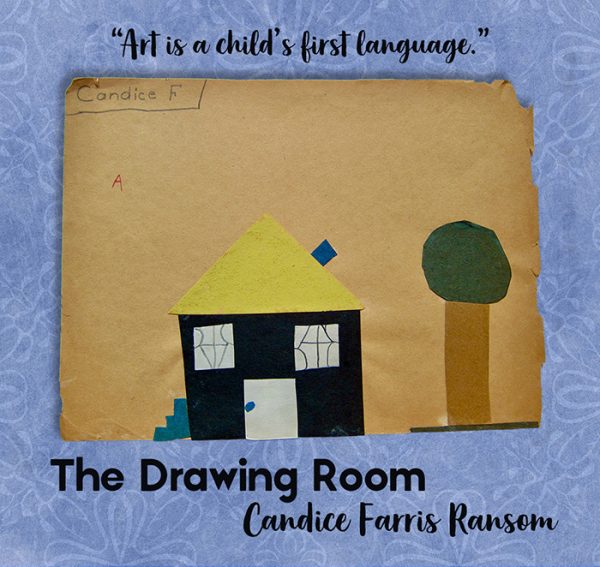
There was a time when drawing and writing were not separated … in the beginning of our writing and reading lives we drew the letters of our name.
Lynda Barry, Making Comics
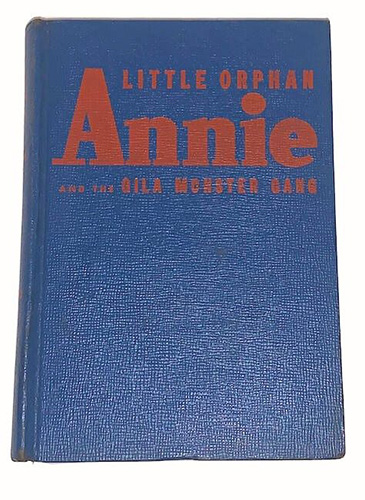
A mother’s 1930’s copy of Little Orphan Annie and the Gila Monster Gang seems an unlikely place for a budding artist and storyteller to start.
This girl had few advantages before beginning school. She did not know her colors, could not count, and could not spell her name. The fall before entering first grade, her stepfather sat her down, printed her name on a tablet, handed her the pencil, and told her to copy the letters. She has never forgotten that evening in which she saw her name written for the first time. The moment when she drew wobbly letters slanting down the paper. Writing her name made her realize she truly existed.
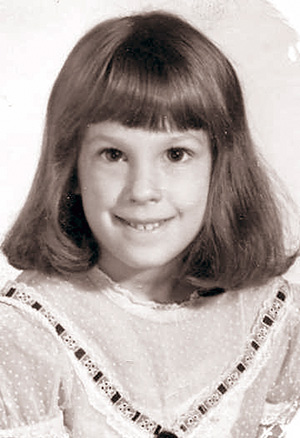 In first grade, even before I could read (for I was that girl), I recognized that drawing was magic. As cartoonist Lynda Barry says, “We draw before we are taught.” I loved drawing. My problem: lack of paper. I found my mother’s old pulp fiction book that contained line drawings. In the blank pages at the back, I copied blank-eyed Sandy from one illustration and a blinged-out girl (me) with Annie’s poufy hair and her lantern, and a boy with pants up to his armpits from my imagination.
In a balloon, I printed “Danny,” my first-grade boyfriend who gave me a Cracker Jack ring to seal our engagement. Danny wasn’t in any of my elementary classes again until sixth grade, so I can reliably date this picture from when I was six. I have no idea why I added sparkly jewels and an evening dress or from where I copied spiral roses. This drawing seems pretty good for a first grader until you see Maurice Sendak’s rendering of Mickey Mouse at age six. It looks better than Walt Disney’s original version.
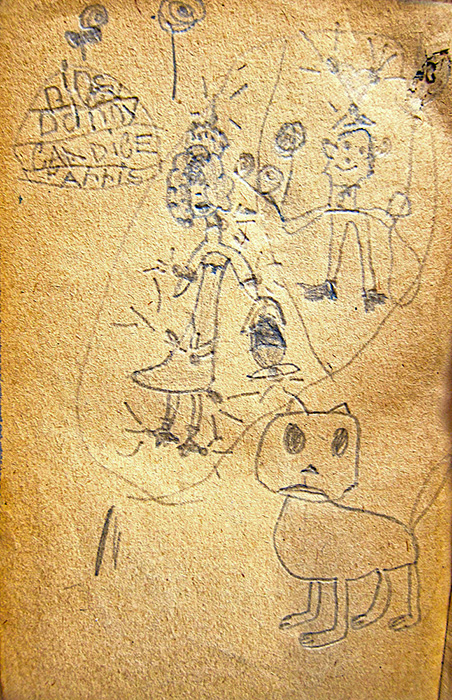
This is the earliest drawing of mine I have. There are no precious scribbles that once hung on the refrigerator. In the house where I spent my first five and a half years with an aunt and uncle, I doubt I had crayons or a coloring book. I don’t know how I learned to progress through the stages of learning to properly hold a pencil. Palmer-supinate grasp, holding a pencil in my fist? Four finger and thumb grip, pencil held vertically between fingers and thumb? Maybe I watched my older sister mastering the pencil correctly with the dynamic tripod grip.
Lynda Barry states,
We draw before we are taught. We also sing, dance, build things, act, and make up stories long before we are given any deliberate instruction beyond exposure to the people around us doing things.
Everything we have come to call the arts seems to be in almost every 3‑year-old. When these capacities are absent in a young child we worry about them.
No one worried about me. I’ve always carried memories of living in that abusive house, the bad things that happened to me. They stay in my body. I’ve since learned that I experienced multi-types of abuse: Child Physical Abuse (CPA) and Child Emotional Abuse (CEA) along with emotional and physical neglect. I have an ACEs (Adverse Childhood Experiences) score of 8 out of 10. The score can be ameliorated by the presence of a kind teacher, other relative, or neighbor. There was no one.
As I grew older and confided some of my experiences, I was told to “get over it.” Now in my 70s, I still have startle response, a physiological reaction from abuse. Childhood trauma, I’ve read, causes changes to the brain. Once out of the abusive situation, I trembled if anyone spoke to me. I couldn’t learn to tie my shoes (for years) or tell time. I couldn’t ride a bike or roller skate. I couldn’t play games very well because I couldn’t follow the rules.
According to the website Little Big Artists, my drawing in my mother’s book places me in the pre-schematic stage (3 ½ to 7 years), “in which patterns begin to emerge — a child draws a pattern and then labels it as a representation of things. The child loves the process and is proud of the result.” Oh, yes, she did.
Lynda Barry once again: “When very young kids draw, they cause the lines that cause something to appear … To have any artistic skill to do this, you just need to be brave and sincere.” Once my mother remarried and my new stepfather took us out of that house, I felt safe for the first time. I was five and a half. I had crayons. The brave, sincere lines I made became my lifeline.
When drawing and then reading leads to storytelling
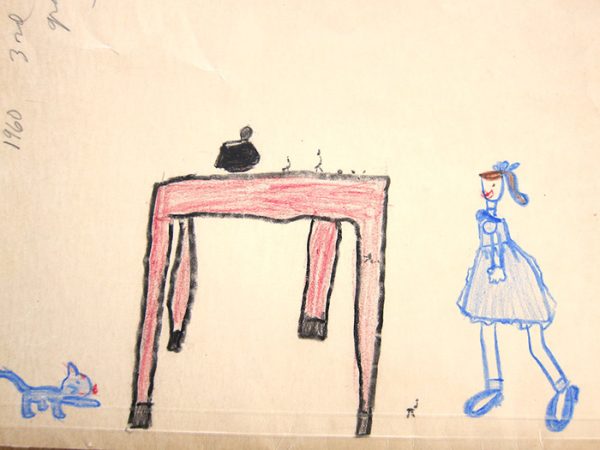
In third grade, when I was eight, my teacher the class asked to keep our good papers in a folder. We could decorate the cover. I chose to draw a self-portrait, wearing a crayon-blue dress and blue shoes (that I didn’t have) with my gray-blue cat and my ant farm science project. My stepfather had captured the anthill for me, kept in a Mason jar so I could observe their behavior. My mother sewed a black skirt to cover the jar. I’m smiling in my drawing.
Even a timid child can draw and tell a story. The following excerpt is from a 1954 lecture by children’s illustrator Taro Yashima. Yashima, before he came the United States to make books for children, taught an art class in his native Japan.
A mother came with a three-year-old boy. He carried a large shopping bag in which was a clean sheet of paper and a crayon. He came stepping inch-by-inch, very frightened, and it was obvious that he did not know what drawing is.
He sat for a long time without doing anything, even after I had asked him, “Can you make a triangle?” and he had answered, “Yes.” Finally he made a tiny tiny triangle way down in the corner of his paper. His classmates teased him saying, “It looks like the head of an ant.”
“It is the head of an ant,” he said, and put body and legs to it. Then he made a house from a larger triangle and it grew into a trolley car, then he made more ants — hundreds of ants and more houses and streets — until he had created a “City scene of ants” such as no one could possibly have imagined.
Lynda Barry weighs in, “When we drew, we watched the drawing happening, we saw it turn from one thing into another.”
Sometimes, the drawing would uncover a hidden situation. Studies show that through some children’s self-portraits, abuse can be detected. For example, missing body parts such as hands or empty eyes, or the figure of the child drawn very tiny beside an oversized adult figure.
A child’s drawing can tell a story. It can also reveal a hard truth.
The starling in the park
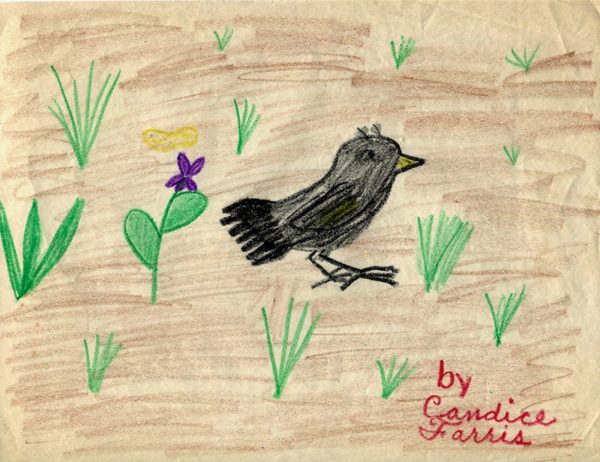
Those five and a half years I lived with my aunt and uncle, I never understood family dynamics or where I fit in. I rarely saw my mother. My sister talked about our father, but I had no idea what a father was. He left after I was born. When I was seven, happily living with my mother, sister, and stepfather, my father promised to take me and my sister to the Ice Capades. We were beyond excited. It would be my first time staying at my father’s and stepmother’s apartment. And my first time ever with my father.
When we arrived at the D.C. Armory on the day of the show, we were informed the event was sold out. My father had neglected to get tickets. (On purpose — my father knew you had to have tickets to get in the movies, much less a big production.) Instead, he drove us to Drug Fair and gave us each five dollars. I’d never seen so much money. I bought a big stuffed donkey I named Buckingham (after the apartment complex), a Tom and Jerry comic book, and new crayons. My sister bought make-up which our father made her take back.
Afterward, Daddy pretty much ignored us. The apartment was situated in a small park. I went outside and discovered a baby bird that had fallen from its nest. I ran back in and asked Daddy to come look, snatching an unshelled peanut from a dish for the bird on my way back out. The bird was still there, all alone. I set the peanut not far from him. My father declared the bird was “only a common starling” and “nobody wants them around.”
Inside again, I asked Daddy for a piece of paper. He gave me a single sheet with a smooth texture, nothing like the rough, oatmeal-colored tablets we used in school. At the kitchen table, I sat down with my new crayons and drew the starling from memory, down to the fluff on its head.
I was eager to show Daddy my picture, to hear him tell me what a good drawer I was. Before I could, my stepmother’s son came in with his little girl. Vicky was younger than me and with curly blonde hair and blue eyes. She ran to Daddy and threw herself at him. “Grandaddy!” she cried. “Pick me up!” Daddy picked her up, kissed her cheek, then swung her around. He did not see me standing there with my picture. He had never kissed my cheek or twirled me in a circle.
I felt like that baby starling, common and unwanted. My heart folded over. I knew then that Daddy loved Vicky and he would never love me. Later, when I grew up and observed other families, as I did my ants, I realized that just because parents have children, doesn’t mean they will automatically love and protect them. It was the hardest lesson I’d ever learn.
Luckily for me, my stepfather taught me lessons I treasured my entire life: the names of trees, birds, animals, and how to tell the weather by the clouds. He taught me to write my name, which made me want to learn to read. He gave me the gray-blue kitten.
I still had my new crayons. When I drew pictures of birds and horses and cats, he was amazed and said I was a good drawer. My heart blossomed. Equipped with paper, pencil, crayons, and encouragement, I was ready to draw the world.
Coming Soon
“Draw the World: Pictures and Stories – Part II, featuring Harold and the Purple Crayon by Crockett Johnson, The Pencil by Allan Ahlberg and Bruce Ingman, and Make a World by Ed Emberley.
Sources
“About Adverse Childhood Experiences.” CDC website.
Barry, Lynda. Making Comics. Montréal: Drawn & Quarterly, 2019.
Jaroenkajornkij, Nisara et al. “Use of Self-Figure Drawing as an Assessment Tool for Child Abuse: Differentiating between Sexual, Physical, and Emotional Abuse.” National Library of Medicine. 2022.
Lander Spain, Frances, ed. The Contents of the Basket: And Other Papers on Children’s Books and Reading. New York: New York Public Library, 1960. (Taro Yashima, “On Making a Book for a Child.” Lecture. 15 November 1954.)
“Drawing Development in Children from 0 to 17 years,” Jimena Catalina Gayo, Little Big Artists, undated
Starecheski, Laura. “Take the ACE Quiz – And Learn What It Does and Doesn’t Mean.” Shots, NPR, 2 March 2015
“The Five Stages of Pencil Grip Development” Teach Handwriting blog. 14 November 2019.
I really enjoyed this glimpse into your artistic journey. I look forward to part two.
Thanks for reading, Mindy. I’m bringing back long-form essays, more than a blog post, with research. I hope you enjoy the next installment and future essays!
Your article inspired me to dig out an old grade school scrapbook. I found a story told mostly in drawings about making an apple pie. Think I was about 7 when I made it. I found it interesting that I focused great attention on the apple tree not wanting to give up its apples. Maybe I had just watched The Wizard of Oz. Or maybe empathy for living things was emerging… And telling a story from multiple perspectives was happening too. The mom was getting impatient waiting for more apples to be picked to make the pie.
Thank you for sharing the stories behind your drawings. Much food for thought!!
Sorry for very late reply, Connie. Your childhood story about making an apple pie shows promise of a young writer (and artist!). I remember your storyboard for your Fishing Dog story when we were at VCFA. You were an art- and mark-maker at an early age!