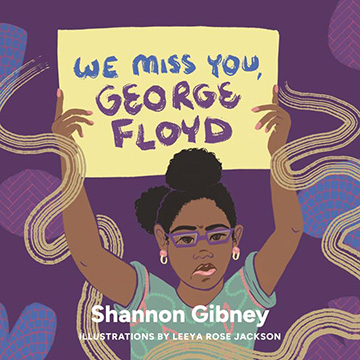
 We Miss You, George Floyd, written by Shannon Gibney and illustrated by Leeya Rose Jackson starts with “we.” “We heard about a man who was murdered by police.” The book recounts, in spare language, the brutal facts of the murder.
We learn George Floyd was part of WE. He was a neighbor, a security worker, and “He made everyone there/ laugh when he showed off/ his bad dance moves.” When the narrator goes to the George Floyd memorial she sees the art that has been made by visitors who’ve come from nearby and far away. She makes her own art and says, “I will keep on making art to remember/him and all the other Black people who/ were killed by police in my town.”
The books ends with “we.” “We will not forget. / This is an old fight./…We know you are with us when we march, /protest, vote, organize, and tell our stories. /”
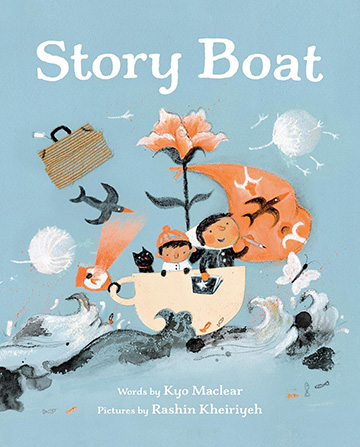 Story Boat, written by Kyo Maclear and illustrated by Rashin Kheiriyeh, is a refugee story told in first person plural. At first the we in the book is a girl explaining to her brother, “Here we are,” as they walk with their few possessions and with other refugees. As the story progresses, “here” is also a cup “old and fine, warm as a hug” that they sip from that also becomes a boat they ride in. “And this cup is a home.” Here is “a blanket, patterned and soft, the color of apricots” that they snuggle and dream under and also a sail for their cup of a boat. Here isn’t always the same. Sometimes it’s a lamp that they read and write by and wonder, what will we be? The lamp is also a lighthouse guiding their cup of a boat with its blanket sail. Here expands to include the other refugees with a song that everyone can sing. Art shows the cup boat grown large enough to hold all the refugees they are travelling with, sailing toward a town and a pier, where folks rush out to welcome them gladly.
Through small things that contain home — a cup, a blanket, a song — and through the stories the children tell themselves, the we expands to include all refugees in search of home.
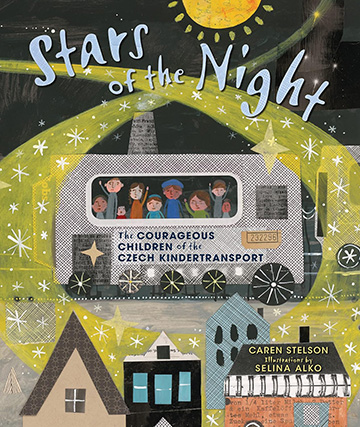 Stars of the Night, the Courageous Children of the Czech Kindertransport by Caren Stelson, illustrated by Selina Alko, uses the collective we voice of the Kindertransport children from the very first line.
“When we were seven or eight or nine or ten, our home was the old city of Prague.” As children they picnicked in the parks, counted the boats on the river, ate their mothers’ sweet honey cake. In winter they skated, walked with their fathers to coffeeshops for cocoa and whipped cream, and went to school with friends. “Prague was everyone’s peaceful home until it wasn’t.” With Hitler’s rise Jews were attacked in Germany, and, in Prague, former friends yelled insults and threats at Jewish children.
In 1939 when Hitler’s soldiers marched into Prague, the parents sent their children to England for safety, telling them, “Dear ones, this is your ticket to life.”
In London their new “families” greeted them. Years went by. Finally the war ended. “When we were seventeen or eighteen or older, we traveled back to Prague.” Although they searched hard for their families, most of the children never found them.
Fifty years later, they learn the name of the man who arranged the Kindertransport, Nicholas Winton. He was still alive, and many of the Kindertransport children, now grown, met the man who had saved 669 of them. And by saving them, saved their children, grandchildren, and all the children to come. “We will forever whisper our thanks to him.”
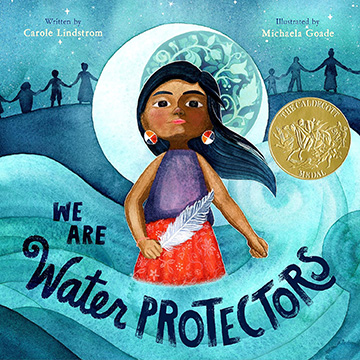 We Are Water Protectors by Carole Lindstrom, illustrated by Michaela Goade begins in a single voice, a young girl explaining what her grandmother has told her, that “we come from water.” Water nourishes the people, and the rhythm of rivers runs in their veins. Stories telling of a black snake that will destroy the water on which life depends take the current-day shape of pipelines carrying oil, pipelines that leak and poison the water and the land. The voice of the book alternates between the narrator speaking for herself — “I must rally my people together” — and the communal voice speaking for all the people.
“We fight for those
Who cannot fight for themselves:
The winged ones,
The crawling ones,
The four-legged,
The two-legged,
The plants, trees, rivers, lakes,
The Earth.
We are all related.”
The final spread shows a crowd of people proclaiming,
“We are water protectors.
We STAND!
The black snake is in the fight of its life.”
Backmatter tells how the Standing Rock Sioux Tribe fought to protect their land and water from the black snake of an oil pipeline. Sadly, the pipeline went forward, leaking before it was even finished. This is not just a Native American issue, the author tells us. “Water affects and connects us all,” she writes. “We must fight to protect it.” Stunning art in deep, rich colors flows across the pages. It is easy to see that this is a Caldecott-worthy book.
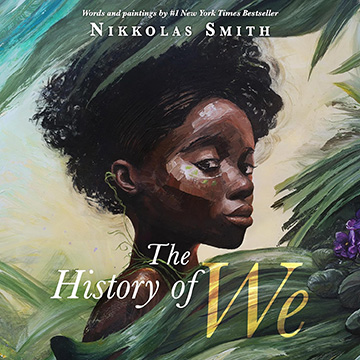
In his dedication for The History of We author Nikkolas Smith writes, “To all kin and next of kin, no matter the tone of skin.” And this is a book for “we,” for all people of all ages. It is a poem with paintings, beautiful paintings. The outstretched brown finger on the first spread recalls the famous fresco by Michaelangelo, “The Creation of Adam.” And the words, “What does ‘the beginning’ look like?” tell us we are starting at the beginning with this history.
“In this fertile African cradle, / The birthplace of civilization is found. /…Let us travel back to the start, so far back / that all of our roots begin to tell the same story. / The original story of humankind. / The history of WE.”
Smith is using eloquent words and gorgeous paintings to make indisputably clear that our human beginnings are in Africa. His respect for these ancient ancestors is also clear. “With minds as intelligent as those born today, /we sculpted words that made stories, and/shared stories that made our community.” He adds that these early humans made music, danced, solved problems, and constructed shelters. “With patience and reverence, we cultivated bountiful harvests. / We grew.” And then, “We set sail /…We explored…. we found new horizons.” The last spread in this beautiful book is a painting that we’d like to see in every post office, every school building, every public building in America. And here are the words to go with that spread: “From the Mother Land, / into every corner of Mother Earth, / one group became many. / Became extended cousins, developing an array of / diverse complexions and forms of prayer. / Became the first global populations… / Became We.”